 Green Air Duct ClubSan Antonio, TX · Since 2009
Home › Blog › Dryer Vent Fire Safety
Your dryer is quietly telling you when its vent is clogged — longer cycles, hotter loads, a laundry room that feels like a sauna. Those aren't annoyances. Lint buildup is one of the most preventable causes of house fires in America, and the warning signs show up weeks or months before it becomes dangerous.
Fill this out and we'll call you back shortly to confirm your appointment.
Prefer to talk? Call (210) 790-3600
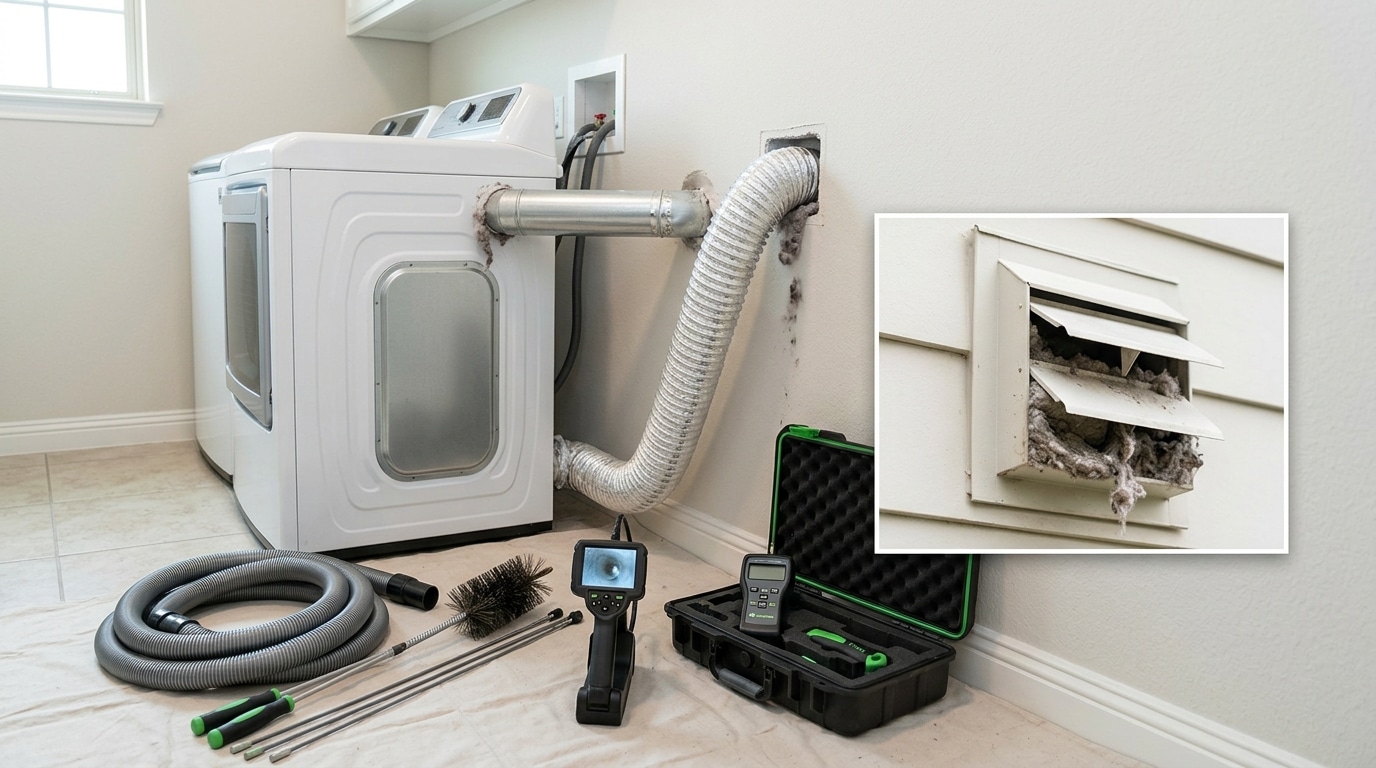
Of all the vents in your home, the dryer vent is the one that can hurt you. U.S. fire officials attribute thousands of house fires every year to clothes dryers, and failure to clean lint out of the system is the leading contributing factor. The good news: a clogged dryer vent almost always announces itself first. Our dryer vent cleaning crews see the same warning signs in San Antonio homes week after week — here's how to recognize them in yours.
Lint is, almost literally, kindling: a mat of tiny dry fibers with enormous surface area. Inside a clogged vent it sits inches from a heating element that cycles to several hundred degrees. As the blockage grows, three things happen at once — the dryer runs hotter, it runs longer, and the lint packed closest to the heat source dries out completely. That's the combination behind dryer fires. The same blockage also drives up energy bills (every double cycle is paid for twice), shortens the dryer's life, and in gas dryers can contribute to exhaust gases backing into the home. A yearly cleaning is cheap insurance against all of it.
Many newer San Antonio builds put the laundry room in the center of the house, which means the vent runs up through the wall and out the roof — a long, vertical line with bends that trap lint at every turn. Those runs clog faster than a short, straight shot through an exterior wall, and they're nearly impossible to clean properly with a hardware-store brush kit. Add big households doing daily loads, and a "we'll get to it eventually" vent can be packed solid within a couple of years. We clean a lot of these in Converse and Seguin and the newer subdivisions all around Bexar County — the roof-exit vent is the local specialty nobody thinks about until the dryer starts struggling.
A proper cleaning covers the whole line, not the easy parts. Our technicians disconnect the dryer, run professional rotary brushes and high-powered air through the entire vent run from the machine to the exterior exit, clear the roof cap or wall cap, remove the compacted lint that collects at every elbow, reconnect everything securely, and verify strong airflow at the outside vent before leaving. You'll feel the difference on the very next load: normal cycle times, cooler operation, and a laundry room that stays comfortable. If we're already at your home for air duct cleaning, adding the dryer vent is only $79 — the single cheapest safety upgrade we offer.
A quick word about vent design, because it decides how fast your vent clogs. The ideal dryer vent is short, straight, and made of smooth metal pipe — lint has few places to catch and the dryer's own exhaust pressure keeps the line fairly clear. Every elbow, every extra foot of run, and every section of ribbed flexible hose works against that. Long runs that exceed what the dryer can push sometimes have booster fans installed mid-line; those fans help, but their blades collect lint too and need the same periodic cleaning. Roof exits add one more catch point: the cap screen or flap where the line terminates, which is often where we find the densest plug of all. If your laundry room sits in the middle of the house, assume your vent is one of the long ones and keep it on a strict yearly schedule — it's the homes that can't see their vent exit from the laundry room that get surprised.
Fire safety is the urgent reason to clean a dryer vent, but it isn't the only one — the same clog quietly taxes you every week. A dryer with a clear vent dries a typical load in one standard cycle. As the vent restricts, cycle times stretch: first a few extra minutes, then a second cycle for heavy loads like towels and bedding, then a second cycle for nearly everything. Every one of those extra minutes is electricity or gas you're paying for to heat air that can't leave. Over a year of family laundry, the wasted energy alone can rival the cost of the cleaning — and that's before counting the appliance itself. Dryers are built to run with free airflow; run one against a blockage long enough and the heating element, thermal fuse, or motor gives up early. A replacement dryer costs many times what a vent cleaning does, and the "repair" that actually fixes the problem usually turns out to be the vent, not the machine.
There's also the moisture angle, which matters in San Antonio's climate. A dryer moves gallons of water out of your clothes as vapor over a year of laundry. With a clear vent, that moisture leaves the house. With a clogged one, a share of it leaks back into the laundry room and wall cavities — feeding exactly the kind of damp conditions that let mold take hold elsewhere in the home. A clear vent is doing quiet work for your whole house, not just your dryer.
If your dryer is showing even one of these signs, the vent is already restricted — and the fix takes under an hour in most homes. Booked on its own or added to a duct cleaning for $79, it's one visit and the problem is gone. Call (210) 790-3600 and we'll clear it.
Complete duct cleaning for one flat price per system — unlimited vents included, before-and-after photos on every job.
📞 Call (210) 790-3600Once a year is the standard recommendation for most households. Large families running daily loads, homes with long vent runs or roof exits, and anyone with pets may need it more often. If your dryer is already showing warning signs, don't wait for the calendar.
No. The lint trap catches only part of the lint — the rest travels into the vent line, where it accumulates at bends, joints, and the exterior cap over months and years. The trap is daily maintenance; the vent line still needs a periodic full cleaning.
Many San Antonio homes — especially newer builds with interior laundry rooms — route the vent up through the roof. Those long vertical runs clog faster and are harder to clean without professional equipment, which is exactly why they get neglected.
We disconnect the dryer, clean the entire vent line from the machine to the exterior exit — including roof caps — remove compacted lint at every bend, reconnect everything, and verify airflow before we leave.
Yes. A dryer fighting a blocked vent runs hotter and longer, which wears out heating elements, thermostats, and motors early — on top of the higher energy bills from double cycles. Many 'broken dryer' calls are actually vent problems.
More guides from the Green Air Duct Club crew:
Full lint removal from the entire vent line — safer dryer, faster loads, lower bills. $79 when added to a duct cleaning visit.
Read more →Bundle and save: what duct cleaning costs, and why adding the dryer vent to the same visit is the cheapest way to get both done.
Read more →Dryer vents need attention yearly — your air ducts run on a different schedule. Here's the honest breakdown for both.
Read more →Booked with a duct cleaning, dryer vent cleaning is just $79 — one visit, and the most fire-prone vent in your home is clear. Call (210) 790-3600.
📞 Call (210) 790-3600 Book Online